
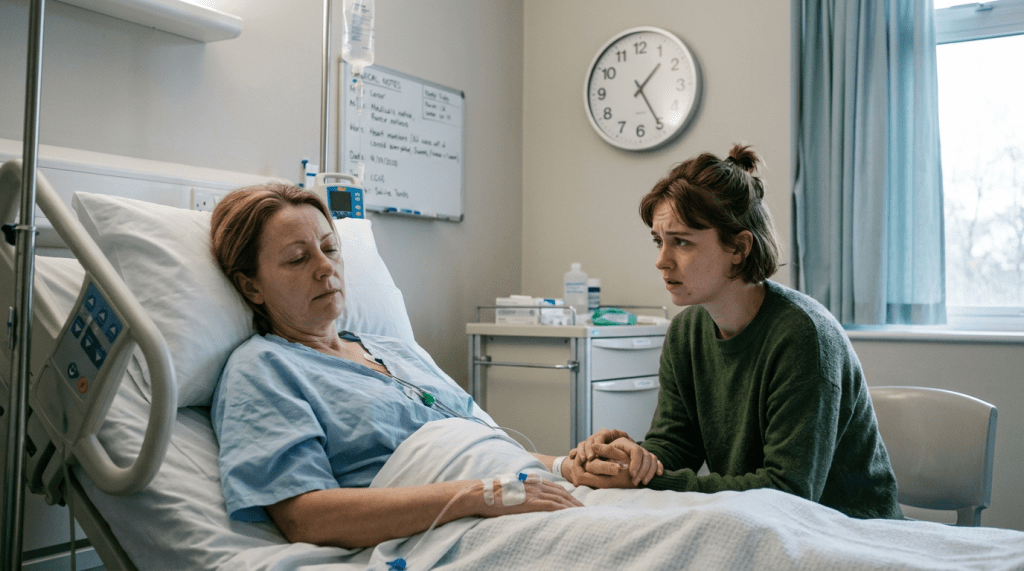
A nurse says a specialist will be by sometime today. No window, no estimate, just a day. For the patient, that single sentence decides how every hour that follows gets spent.
The patient can’t nap, because sleep might mean missing the one visit that answers the question they’ve been waiting days for. Can’t watch a full movie, can’t lose focus in a book, can’t step away for a walk down the hall.
Every knock on the door registers as a possible arrival, and most of them aren’t. By the time the specialist actually walks in, hours later, the patient is worn down from staying alert rather than resting.
The caregiver runs a parallel and separate calculation. They can’t be there for the whole day, so they choose to be there for the part that seems most likely, but “most likely” is a guess dressed up as a plan.
Arriving early avoids missing a repeat of yesterday. Skipping breakfast follows the same logic: stepping out of the room for ten minutes has meant missing someone before. Afternoon turns to evening before the visit happens, and the day gets absorbed by waiting rather than any of the things it was supposed to hold: work, other family, rest.
In my experience, and in stories from other families, the same pattern shows up again and again, across different hospitals, different patients, different specialists. The same promise, the same undefined day, the same nurse saying “they’re on their way” hours after the visit was supposed to happen. That kind of consistency says less about any single hospital and more about how rounding tends to get built, unevenly, across many of them.
There’s a cost to waiting, and both sides pay it.
On the patient’s side, it’s energy, and energy is exactly what someone recovering from illness or surgery lacks most. Waiting isn’t rest. Resting means the body can let go of vigilance. Waiting means staying alert for a knock that might come any minute, which keeps the body activated rather than restoring it.
A patient who stays “ready” for eight hours has spent the day working, even lying down.
On the caregiver’s side, it’s time, and time for a caregiver is a fixed, already overcommitted budget. Most caregivers juggle a job, other family members, and their own health against a limited number of hours they can be present.
An open-ended wait costs more than the hours spent in the room. Those same hours could have gone toward any of those other obligations, except nobody could say in advance which hours would be needed.
Two separate costs, on two separate people, adding up to as much as a lost day.
Many hospitals that can’t say when a specialist will visit can still tell a patient, to the minute, when an MRI is scheduled. Many that can’t offer a window for rounding can hand a patient a printed schedule for surgery, complete with an arrival time, a prep time, and an expected start. The precision exists elsewhere in the same building; it simply hasn’t reached rounds and consults.
Hospital staff aren’t careless, and scheduling as a discipline already exists inside the building, tested daily for procedures. Extending that same discipline to rounds and consults isn’t a technical leap. Somebody just has to decide that a patient’s day is worth planning too.
Outside a hospital, most industries gave up on an entire day as an answer a long time ago. A repair technician gives a window, not a date. Airlines announce a boarding time, not “sometime this afternoon.” A restaurant that can’t seat a party immediately sends a text when the table is ready, instead of asking a family to stand by the door for two hours.
None of these examples require perfect precision. A four-hour repair window is still four hours of not knowing exactly when. What it offers instead is a boundary: not a guess dressed up as a schedule, but a bounded promise, honest enough to plan around in advance.
A hospital could offer a two-hour window instead of a day. A nurse could send a message when the specialist is two rooms away, the same way many restaurants and airlines already do. Neither idea requires new technology or additional staff, just a decision to treat a patient’s day as something worth bounding.
The point here isn’t to lay blame on anyone working inside a hospital. Clinicians and schedulers manage caseloads that shift by the hour, emergencies nobody can predict, and constraints most patients never see. The people doing the work are, by every account, doing their best inside a design they didn’t choose.
The ask is smaller than it might sound. Add one more variable to the design: the patient’s day, and the caregiver’s limited hours in it. Give a window instead of a promise. Send a message instead of asking someone to stand by a door. Treat time, for the person in the bed and the person driving in to see them, as a resource worth planning around, the same way hospitals already plan around an MRI slot or a surgical suite.
Nobody is asking hospitals to predict the unpredictable. The ask is only that the same discipline already used for procedures gets extended to patients and caregivers too.
That’s the view from the bed, and the design should make room for it.


Leave a Reply