
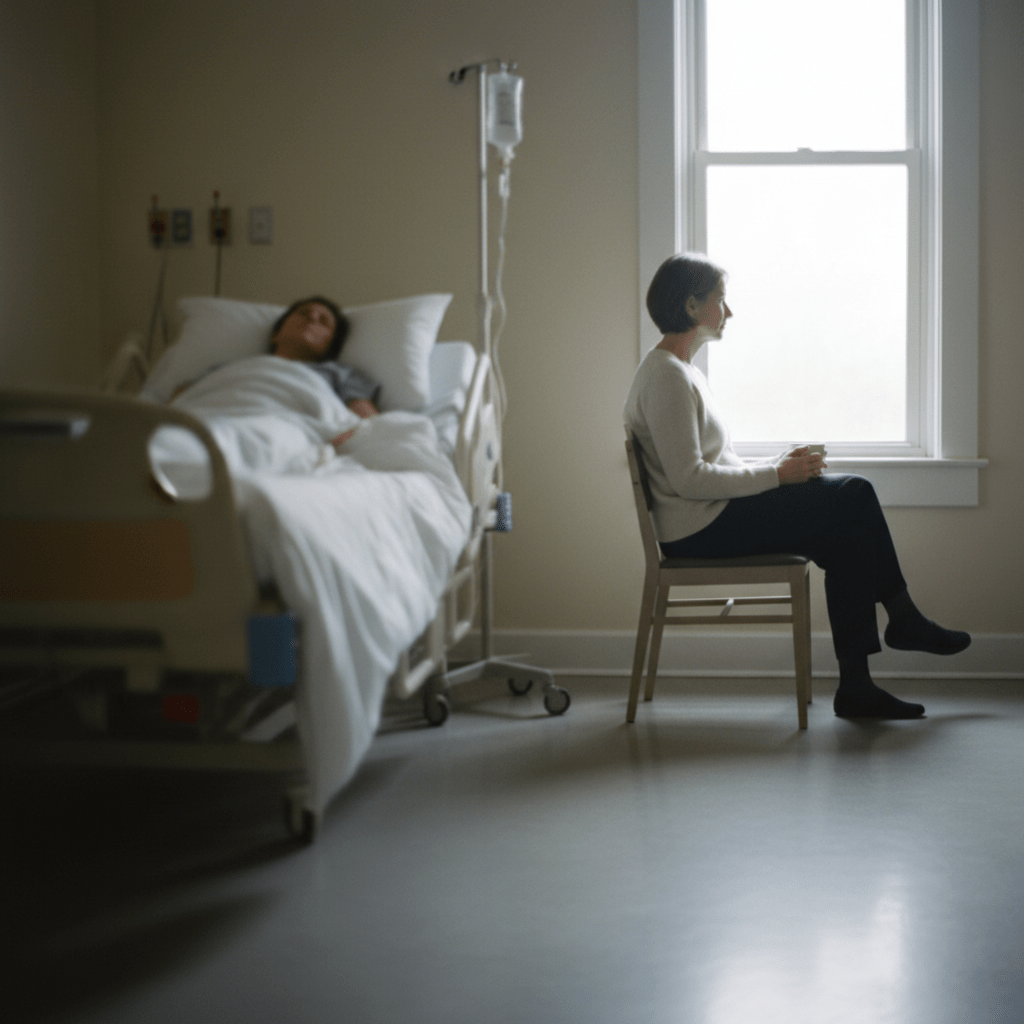
I have been the patient. I have not been the caregiver. The distinction matters before I write another word, because everything ahead depends on holding two roles apart, and I would lose the thread if I blurred my own standing to make the case.
I watched the caregiver. I carried the illness while my wife, Tracy, carried everything around it. I learned the shape of her work by living beside her, the way she learned the shape of mine. What I know of caregiving, I know as a witness.
The people who design programs for patients tend to treat the two roles as one. They build a portal and call its user the patient. They convene a committee and seat the patient and the family at a single table. They write a strategy and address patients and their families in a single breath. The habit is easy to understand, and my quarrel is not with the habit. They pass over a difference, and the difference is my subject.
The difference is not mine alone to name. The Canadian Centre for Caregiving Excellence published a National Caregiving Strategy in 2025, costed and endorsed by some fifty disease and aging organizations, holding the caregiver apart as a role with needs of its own. The work those caregivers do without pay would cost the federal government an estimated ninety-seven billion dollars a year to replace.
A patient lives inside the illness. A caregiver lives beside it. Inside and beside are not the same thing measured twice, and what they produce is not the same either: different knowledge, different time, different fear.
A friend of mine cares for his wife through a serious illness. He went out one night for a few hours among friends, the illness left at home. For a little while the evening was his own. The questions started soon enough. Every one of them asked how she was doing. Not one asked how he was doing. The one night he came to set the caregiving down, the room would not let him.
The pattern holds wherever a household turns toward illness. The patient draws the eye, the questions, the casseroles at the door. The caregiver stands a step to the side, doing the work that keeps the patient afloat, and goes unasked. Concern is not a fixed quantity, yet it pours toward the bed as though it were, and little reaches the person holding everything up.
Caregiving keeps a firefighter’s hours. A firefighter sits calm until the bell, then moves at once, completely. The caregiver lives in the same posture, alert beneath the quiet, and the bell has a habit of ringing at two in the morning. The dread is not the emergency. The dread is the wait for one.
The caregiver also lives in a fear set in a time I did not have to face. I feared my own death. Tracy feared the life on the far side of it. Had the illness won, I would have been gone, released from the aftermath, while she would have remained to carry our grown children through their grief and her own, and to settle the hundred ordinary things a death leaves behind. A patient reaches an end. A caregiver keeps walking into a future the patient will never see.
Tracy did not hold to her old life. The illness took it. She built a new routine in its place, deliberately, coming to the hospital on the hard days and, on the better ones, tending her own life even when I wished she were there. Her choice cost me something before I understood it. I read her absence as distance, and I read it wrong. The new shape she made for her days was what kept her whole.
A patient cannot step outside the illness. The illness travels wherever the patient travels, with no door to close against it. A caregiver stands one step back, near enough to be consumed and far enough to resist, and the work of resisting is work the patient never has to take up.
I was the patient. I will never know what it was to be the caregiver. I learned that much by watching the person beside me, and watching was as close as I came. I have not looked at a caregiver the same way since.
Thanks for reading,
Mike


Leave a Reply