
“Those who build walls are their own prisoners. I’m going to go fulfill my proper function in the social organism. I’m going to unbuild walls.” — Ursula K. Le Guin
Throughout my stem cell transplant journey, a PICC line was my constant companion. A peripherally inserted central catheter is a long, thin tube threaded through a vein in my arm and into a large vein near my heart. The PICC served as the highway for the chemotherapy that preceded my transplants, the medications that followed them, and everything in between.
Keeping the PICC insertion site clean and sterile was not optional for an immunocompromised patient. Infection can be fatal. So every week, a home care nurse arrived at my door to change the dressing, and during periods when I was on daily IV medications, she came every day.
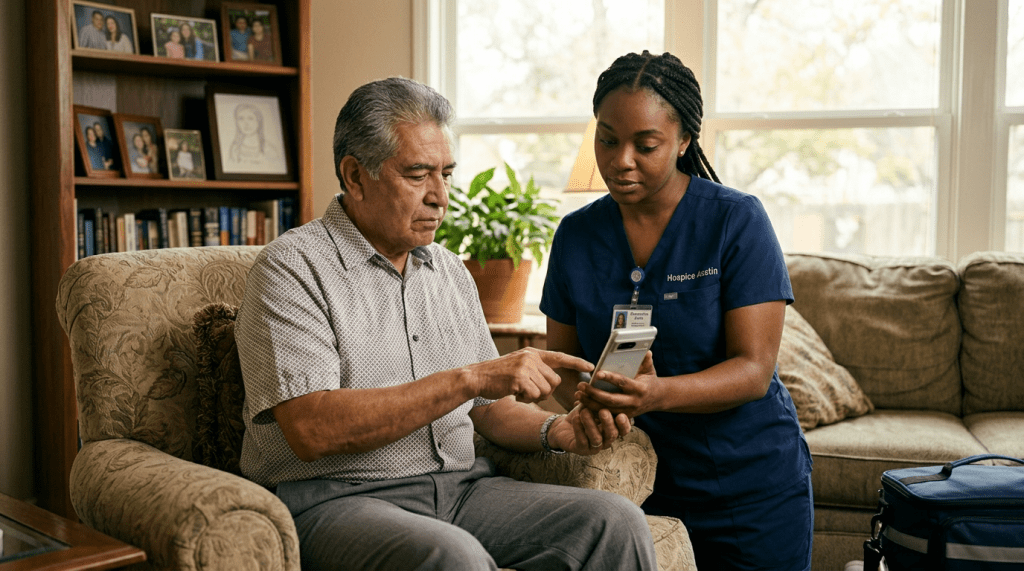
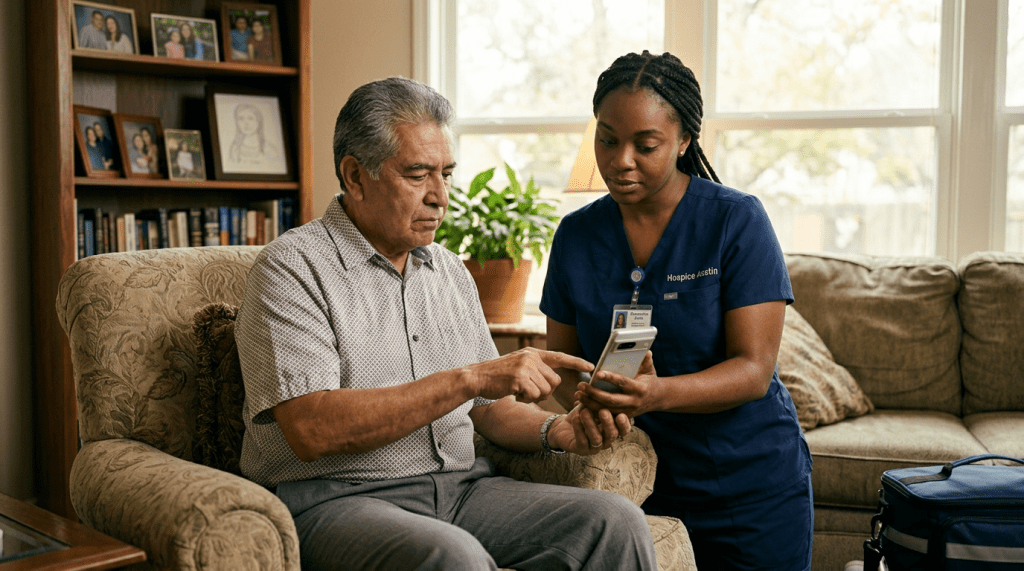
One week, almost in passing, she told me that home care nurses had no access to hospital health records. Following that revelation, I started sharing my clinical notes with her on my phone.
That moment, a cancer patient holding up a smartphone so a home care nurse could read his own clinical notes, is everything wrong with Canadian health IT in a single image. That information was supposed to flow through a system. Instead, it flowed through me.
Functionally, I am acting as a “Health Information Exchange,” the system that is supposed to move clinical data between providers so that everyone caring for me knows what everyone else has done. Not a platform. Not a pan-Canadian interoperability roadmap. Me. A patient, managing the flow of my own clinical data because nothing else will.
The stockbroker parallel
In the early 1990s, stockbrokers controlled access to financial information. Stock prices, research reports, portfolio analysis all flowed through them. The argument for this arrangement was professional: the information was complex, the stakes were high, and ordinary investors could not be trusted to interpret it without guidance. The real argument, of course, was economic. Information was the product, and gatekeeping the information was the business model.
The internet rendered the gatekeepers irrelevant. Ordinary investors discovered they could go directly to the source, and the brokers had not seen it coming.
Online trading platforms gave those investors the tools to act on what they now knew. The brokers who adapted became advisors. The ones who did not became history. The disruption was not hostile. It was structural. Once the information was accessible, the old arrangement became unsustainable.
Clinicians and vendors have made the same argument about patients and their own health information for decades. The information is complex, the stakes are high, and patients cannot be trusted to interpret it without guidance. The real argument is more complicated. For clinicians, it is professional identity. For vendors, it is a business model. The patient appears to be an afterthought in both cases.
That argument persists in healthcare long after it collapsed in financial services. Ordinary investors got around the stockbrokers. Patients are still fighting to get around the gatekeepers.
I am one of those patients still fighting. I download my lab results after every blood draw and my consult reports after every specialist appointment. I use Claude to help me interpret them and prepare for appointments, not to replace my medical team, who are extraordinary and whom I trust completely, but to arrive as an informed participant rather than a passive recipient. To ask better questions. To understand what is happening to my body in the hours and days between clinic visits, when no one from the system is present.
The gatekeeping model has not collapsed in healthcare the way it did in financial services. But the patients who want their data are getting it, one download at a time. The question is whether the system will adapt before it is forced to.
Regina Holliday and the data she never got
I am not the first patient to fight this battle, and the history of those who came before me is not encouraging. In 2009, a woman named Regina Holliday discovered just how much was at stake when the system refused to share her husband’s records.
Fred Holliday was 39 years old when he was diagnosed with kidney cancer.
Over the eleven weeks that followed, Fred was treated at five different facilities. Regina spent those weeks trying to get his medical records. For five days she begged doctors and nurses for access. For five days she received nothing.
On the sixth day, Fred needed to be transferred to another hospital, and he went without his complete records.
When Fred arrived at the receiving hospital, the clinical team could not administer pain medication. They did not know what drugs he already had in his system. Regina ran back to the first hospital to retrieve the missing records. For six hours, Fred was in pain, frightened, and alone. He died two months later at the age of 39.
After Fred died, Regina painted a mural called “73 Cents.” The title refers to the cost per page that the state of Maryland charged patients for copies of their own medical records. The mural depicts her husband dying in darkness, surrounded by inaccessible technology in a closed data loop.
Regina became one of the most prominent patient activists in the United States, and her rallying cry was simple: “Give us our damn data.”
That was 2009. Sixteen years ago.
Regina’s cry came from grief, not policy. It was personal. So is mine. Not as a political slogan. As a clinical necessity.
When my home care nurse arrived with no information about my condition and I compensated by showing her my phone, I was not demonstrating patient empowerment. I was demonstrating system failure. The burden of integration had been placed on the one person least equipped to carry it: the sick one.
The patient as integration engine
Nobody assigned me the role of “Health Information Exchange.” The system simply left the position vacant and I filled it.
Every record I downloaded had to be organized, cross-referenced, and kept current. When something changed, a new medication, a new finding, a new referral, I made sure the relevant people knew, because the system would not reliably tell them.
When my home care nurse arrived each day during IV treatment, I briefed her on what had happened since her last visit. When I see my cardiologist at the University of Ottawa Heart Institute, I bring a summary of what my hematologist at The Ottawa Hospital has been doing. When I see my hematologist, I mention anything relevant from my cardiac care.
I am the connective tissue. I am the integration layer.
Consider what a system boundary looks like from the patient’s side. The Ottawa Hospital runs one platform. My community care providers run another. Those systems do not talk to each other in any meaningful way. When information needs to cross that boundary, it crosses through me.
I am the messenger. I am the bridge. I am the “Health Information Exchange” that has been promised, and funded, and debated, and built in pieces, but has yet to reach the patient at the centre of it all.
There is a particular irony in my situation that I cannot quite shake. I have spent twenty years working in health IT. I understand interoperability standards. I understand why these systems do not talk to each other, the incentives, the procurement decisions, the vendor lock-in, the jurisdictional complexity. And yet here I am, in my own care, doing manually what the industry has spent decades promising to automate.
The Cost Nobody Considers
The burden of acting as your own “Health Information Exchange” is not trivial. Managing records, preparing summaries, and bridging the gaps between care teams demands time, energy, and cognitive capacity, three resources that seriously ill patients cannot afford to spare.
On days when I was most unwell, keeping track of my own information felt like a part-time job for which I never applied. Organizing records. Preparing summaries. Bridging the gap between my hematology team, my cardiac team, my home care nurses, and my family doctor.
Think about who cannot do what I have been describing. The patient who is too sick to sit upright at a computer. The patient whose first language is not English. The patient who does not have a smartphone, or reliable internet, or a family member who can help. The patient who trusts the system to handle the flow of clinical information because no one ever told them the system would not.
Those patients are not exceptions. They are the majority. Hundreds of separate systems were built, each one designed to serve the organization that procured it, each one indifferent to what came before or after at the next point of care.
Every designer thought about the patient within their system. The patient’s journey across all of them does not appear to have been anyone’s concern. The view from the centre of that web, the view the patient has every single day, remains a perspective the system has yet to adopt.
What I am asking for
My mother was a nurse. So were my aunts. So is my sister, who has been beside me through my illness in ways that are difficult to put into words.
I went into health IT in the first place because of my mother, drawn by the work she did and a desire to build systems that would make it easier. Better. More connected.
Decades later I became one of those patients, carrying with me twenty years of knowing exactly why the home care nurse at my door still had no access to my records.
I am not asking for perfection. I am not asking for a pan-Canadian real-time interoperability layer by next Tuesday. I have spent a career in this industry and I understand, better than most, how hard the work ahead will be.
I am asking for information that is already in the system to flow easily within it, and for information that crosses system boundaries to follow the patient across them. I am asking for the nurse at my door to know what happened at my clinic appointment last week. I am asking for a system that treats me as a participant in my own care, not a passive recipient.
The barriers are real. How they got there matters less than what they cost. Patients are not interested in the history of why their records cannot follow them from one provider to the next. They are interested in a future where those records flow freely to everyone involved in their care.
Every patient in Canada is doing what I do. Standing in for the “Health Information Exchange” that has been promised, and funded, and debated, and built in pieces, but has yet to reach the patient at the centre of it all. That cannot be the answer. Patients are not a workaround.
Thanks for reading,
Mike


Leave a Reply