I spent a career helping build Canada’s digital health systems. On a Monday morning, I came to a microphone as a patient.
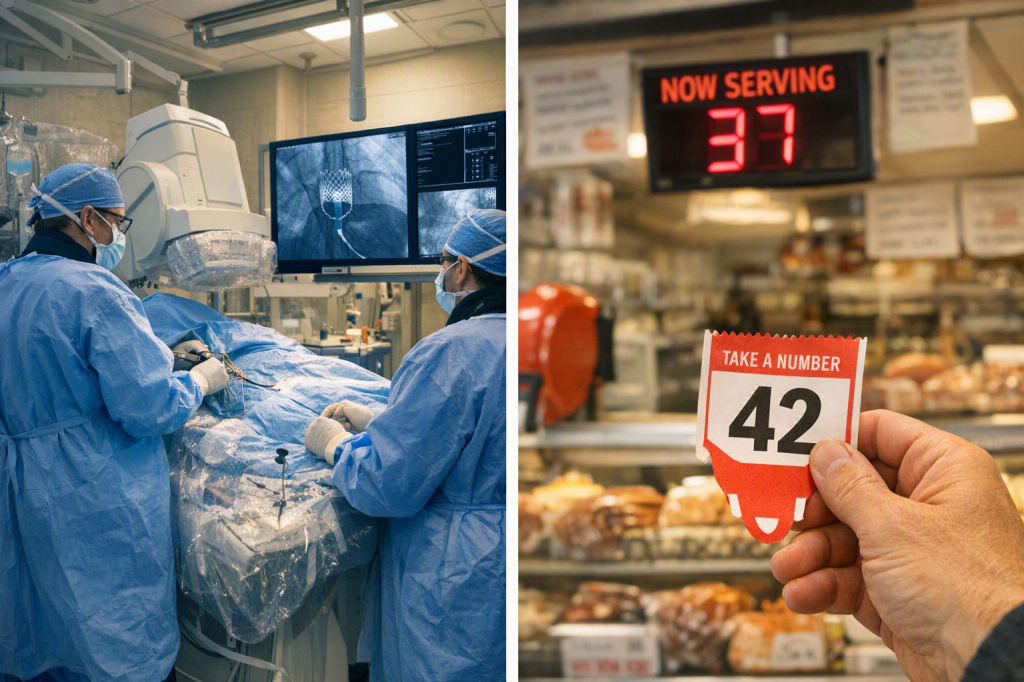
Across from me sat a panel of executives and officials. I told them a short story about my own care. Months earlier, a surgical team had replaced my failing aortic valve through a procedure called TAVI, one of the most advanced cardiac interventions in medicine. They threaded a new valve up an artery and into my heart, and never opened my chest. Days later, I went for routine bloodwork. I pulled a paper ticket and took a number, like at a deli counter. I waited in a room that felt like a bus station.
I put one request to the panel. Match the technology of the patient experience to the technology of the care itself.
Heads nodded, the morning moved on, and I assumed the message had landed.
The event was e-Health, Canada’s national digital health conference, hosted by Digital Health Canada, the Canadian Institute for Health Information, and Canada Health Infoway. This year it came to Halifax, home of NSTN, one of Canada’s first commercial Internet providers.
The next morning, a panel took the main stage to discuss how artificial intelligence could be used across health care. The session description pointed to three groups who stand to gain: physicians, staff, and patients. Of the four panelists, not one was a patient.
To check, I asked an AI chatbot to pull the speaker roster for all 170 sessions and 250 speakers, then verified the patient names by hand against the conference’s own Patient Partner page.
The eHealth 26 program included 3 plenary sessions, a closing keynote, and many concurrent sessions. Across the four sessions attended by all participants, the speakers were hospital and agency executives, senior government officials, and clinicians. No patient appeared on any stage.
The same pattern ran through the wider program. Of 250 speakers, nine spoke as patients, caregivers, or people with lived experience, under four percent of the program. Industry and vendors accounted for 121 of the seats, roughly one patient for every thirteen who sell to the system.
As a patient I have lived the decisions made in my absence.
e-Health does run a Patient Partner program. The conference names ten Patient Partners, gives them a lounge, and invites attendees to find them during breaks. Six of the ten hold a role in a session. Five of those six moderate rather than present, in sessions that carry names like No Patient Left Behind and Power To The Patient In Digital Care.
e-Health is an industry conference, and an industry fills its own rooms. Patients live inside the systems those rooms shape. A conversation that sets the terms of patient care can surely seat a patient.
I have argued before, in a piece called Oxymoron, that “digital health” is a phrase coined by marketers, and that health itself stays stubbornly analog, human, and unpredictable. The speaker count carries the same argument in numbers. We named a conference for digital health, then filled every room in it but the patient’s.
We engineered a miracle into my chest and a deli ticket into my afternoon
Thanks for reading,
Mike
NOTE: The categories rest on each speaker’s stated title and employer, and a few names could fit more than one column. The distance between the largest group and the smallest holds either way.
 Digital Patient
Leave a comment